ELIDEDB

Search your robot footage by describing what happened.

ElideDB is a database for camera and sensor recordings. Type "the arm closes the drawer" and get back every clip where it actually happens, in seconds. No tagging, no labeling team, no scrubbing through timelines.

Try the live demo real product, real robot data, nothing staged
runs on your infrastructure built on open world models from Meta and Google every number on this page is a measurement
elidedb console
> search "the robot arm closes the drawer"
10 clips returned 4.8 s every one playable, newest first
> search "fold a piece of towel"
0 clips returned your footage does not contain that
action, so it says so instead of guessing
the problem

Your fleet records everything. Your team finds nothing.

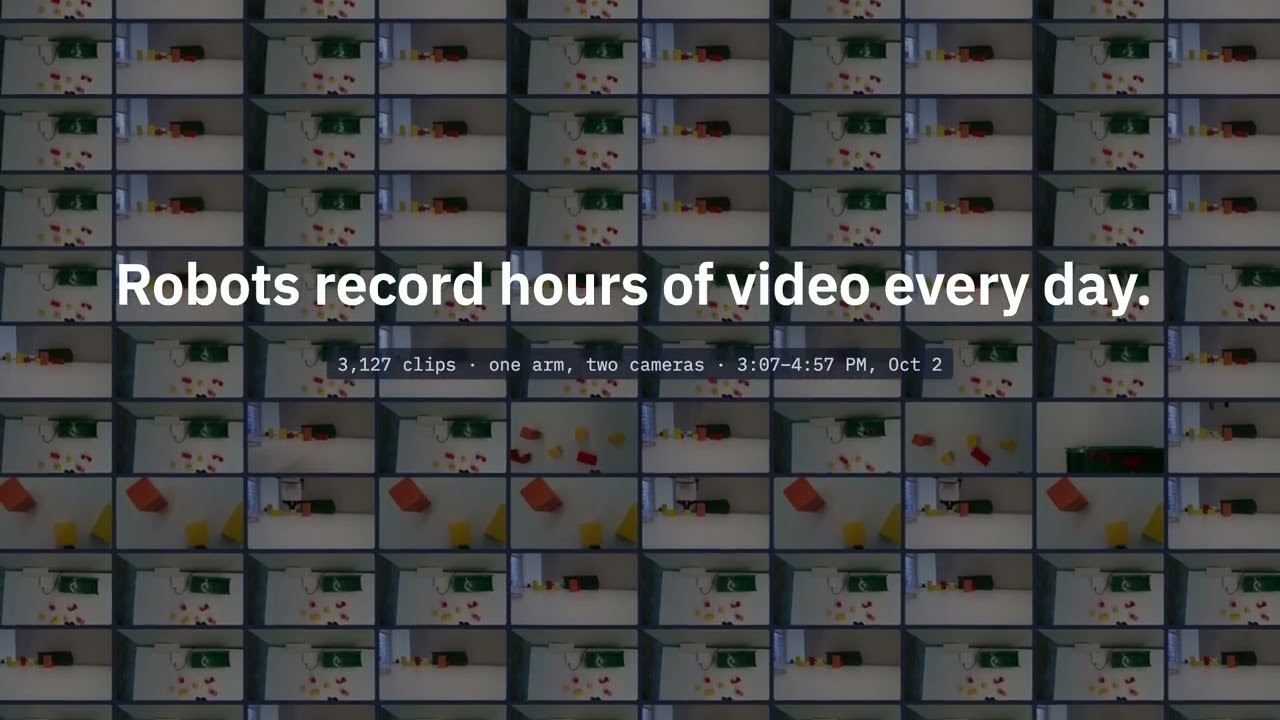
A gripper drops a part overnight. A test drive clips a cone. A customer reports the arm "did something weird" on Tuesday. You have the footage. Somewhere. In hours of recordings across a dozen cameras.

So an engineer opens a timeline and starts scrubbing. That is the state of the art at most robotics companies today: your most expensive people, watching video at 8x, looking for one moment.

Afternoons lost Every incident review starts with hours of manual scrubbing before the real work begins.
Events missed The failures nobody happened to see are the ones that come back in production.
Dark data You pay to store every hour of footage. You can use almost none of it, for training or for answers.
the fix

Ask your footage a question. Get clips, not homework.

1Point it at your recordings Video files and sensor logs go in as they are. Your raw data is never modified or re-encoded.
2Describe the moment Plain words, the way you would ask a teammate. Colors, objects, actions, directions.
3Review only what matters Every result is a playable clip with its exact timestamp. If nothing matches, it tells you that, with the reason.
you are probably thinking

The questions every engineering lead asks us

"We do not have budget for a labeling team."
Good, because ElideDB never asks for labels. It calibrates itself to your footage using open world models. Nothing in it is hand tuned to a dataset, so the same system works on kitchens, warehouses, and roads.
"AI search tools return confident nonsense."
Ours is built to abstain. A question your footage cannot answer returns zero results and the reason, not ten look-alikes. We publish our accuracy the same way we build it: measured on a frozen, hand-graded benchmark, on every change.
"Our footage cannot leave the building."
It does not have to. ElideDB runs on your hardware or your cloud account, on open models, with no per-query API calls to anyone. Your data stays yours.
"We do not want another data silo."
It is a real database, not a black box: one directory of open Parquet files with time travel, SQL, and byte-counted reads. Delete the original recordings and it keeps serving. Walk away and your data is still plain files you can read with anything.
what that buys you

Seconds where you spend afternoons

5 s
a typical question over a thousand episodes, on two CPU cores, no GPU
0
labels, tags, or annotations you will ever write
1
directory holding everything: searchable, portable, yours
< 5%
of file bytes read to replay a moment from an hours-long recording, so storage stays cheap and cold
faq

Fair questions

What footage does it work on?

Any timestamped video plus optional sensor streams: robot fleets, dashcams, factory floors, lab rigs. If it has a clock, it fits on the timeline. Nothing about the engine assumes a domain.

Do we need GPUs?

Not to search. Heavy encoding happens once at ingest; after that, questions run in seconds on ordinary CPUs. The live demo on this page runs on two CPU cores.

Is there a language model making things up?

No. There is no generative model in the answer path. Results come from measurable evidence: vision encoders scoring your actual frames, weights fitted to your corpus, and geometric verification when you ask for it. That is why it can honestly return nothing.

What happens to our raw files?

They are never touched. Ingest reads them once, builds its own compact copy and indexes inside the store, and from then on the database serves even if the originals are archived or deleted.

What does it cost?

We are onboarding early teams now and shaping pricing with them. The honest cost model underneath: every query reports exactly how many bytes it read, and in the cloud that number is the bill.

from the founder

I spent years at NYU building synchronized capture rigs: cameras, LiDAR, and microphones recording city streets for research. We got very good at collecting data. Then I watched every team, ours included, hit the same wall: the recordings pile up, and the only search tool anyone has is their own eyes.

ElideDB is the database I wished existed then. It treats your footage like data instead of dead weight, and it would rather tell you "that never happened" than waste your afternoon on ten wrong clips.

Sudharshan Ramesh founder, ElideDB
see it yourself

Ask real robot footage a real question

The demo is the actual product, read only, loaded with 1,122 robot manipulation episodes. Type a sentence, play the clips it returns. It runs on a small shared CPU instance, the cheapest machine that can hold the whole model stack; production deployments run on your own hardware, next to your data, and move accordingly.